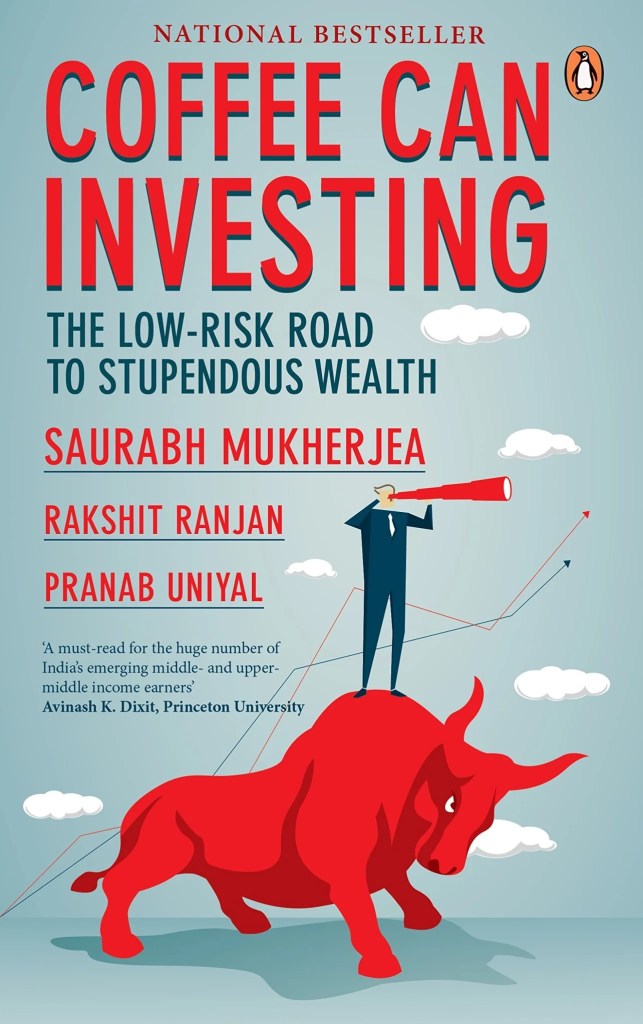
About the authors:
Saurabh Mukherjea is the Founder and Chief Investment Officer of Marcellus Investment Managers. Prior to setting up Marcellus, Saurabh was the CEO of Ambit Capital. He is a CFA charter holder with a Bachelors and Masters in Economics from the London School of Economics.
Rakshit Ranjan launched Ambit’s Coffee Can PMS in Mar’17 and managed it till Dec’18. Under his management, Ambit’s Coffee Can PMS was one of India’s top performing equity products during 2018. He holds a B.Tech degree from IIT (Delhi) and is a CFA charter holder.
Pranab Uniyal is the head (products and advisory) at Ambit Capital. He holds a BTech degree in chemical engineering from Indian Institute of Technology, Madras, and a postgraduate diploma in management from Indian Institute of Management, Calcutta.
Introduction:
Indian people have been typically Indian where the only investment tool is Gold, Real Estate and more or less “Fixed Deposit”. After these options there has been no such growth till last decade. Even in banks the Relationship Managers suggest the old ULIPs which can only be profitable to the distributor rather than the customer.
The portfolio of the Indians got limited due to three major drawbacks of the Indian Investment Pattern
- The overwhelming dominance of investments such as gold, real estate, and fixed deposits. Around 88% of an Indian investor’s wealth is in these three assets.
- The culture of the stock market is only two decades old. It’s relatively new compared to other countries.
- And, unlike in developed countries, the Indian stock market has very few great companies that sustain over long periods.
In this book, the author has advised on how to invest for long term and perks of investing for long term through his Coffee Can Portfolio. He has explained every point with different examples step by step and in detail. Below are the key learnings from the book which one should focus on.
CHAPTER 1: MR. TALWAR’S UNCERTAIN FUTURE
Investors make some very basic investment mistakes that lead to either wealth erosion or sub-optimal returns.
The common investment mistakes every investor makes:
- No clear investment plan/objective
- Trading too much, too often
- Lack of diversification
- High commission and fees
- Chasing short-term returns
- Timing the market
- Ignoring inflation and taxes
CHAPTER 2: COFFEE CAN INVESTING
It is interesting to know that although Sir Isaac Newton invented calculus and made ground breaking discoveries in the field of physics, he could not understand the behaviour of the market and suffered terrible losses at the time. This shows that patience is just as important when investing in stocks.
This biggest misconception in the marketplace is the saying, “To get higher returns, you need to take more risks”. This statement is partially correct when we see it in relation to various financial instruments. However, on a specific instrument; say Equity; You have the option of choosing the most efficient companies for your portfolio, which significantly reduces your risk and keeps the return constant.
A company may be selected for inclusion in the portfolio based on its economic moat it possesses. This moat should be intended to set the company apart from its competitors in the long term. A moat that has to be constantly rebuilt is not a moat.
CHAPTER 5: SMALL IS BEAUTIFUL
Over the past 2 decades, small-caps have outperformed large-caps in most large stock markets. There are two key drivers of this outperformance: smaller companies have the potential to grow their profits much faster than large companies and, secondly, as small companies grow in size they are ‘discovered’ by the stock market.
Over the recent years affluent Indians have directed savings away from real estate and towards financial system. This deepening of the financial markets is helping reduce the cost of capital in India, which in turn benefits smaller businesses disproportionately.
Whilst the scope for generating superior long term investment returns is greater with small-caps, the need for professional help is disproportionately greater.
CHAPTER 6: HOW PATIENCE AND QUALITY INTERWINE
‘Patience Premium’ is the difference between annualized returns generated by a stock or an index over any holding period compared to the return generated by the same stock or index over a one-year holding period. A positive value of ‘patience premium’ implies that the longer the holding period of the stock, the higher is the return generated from it for an investor.
‘Quality Premium’ is the difference between the annualized returns generated by a stock or a portfolio and the Sensex over a particular holding period. A positive value of the ‘quality premium’ implies that increasing the quality of the stock portfolio generates better returns for the same investment horizon.
Observation 1: The shorter the holding period, the higher the quality premium
Observation 2: A high-quality portfolio with a long holding period delivers the highest return with the lowest risk
APPENDIX 2: HOW PUNCHY CAN THE P/E MULTIPLE OF A GREAT COMPANY BE?
A large proportion of investors and analysts use various ratios to value companies by comparing their past, or with their peers. But sometimes ratios like P/E and PEG can skew the actual picture of shareholder value creation and make it look rosier than it is. The interesting thing about earnings is that not only can they be manipulated according to the whims of the management team, but they only provide information about how much profit a business can generate every year and NOT about the re-investments of those earnings necessary to keep the business running. The cash flow, on the other hand, describes clearly how much of the profit is left for shareholders.
 Dhruvesh’s Blog